
Jean Measurement Chart
Jean sizes are notoriously inconsistent, but good measurements make buying online much easier. Measure your waist, hips and inseam — or a pair of jeans that fit well — and this chart and size finder suggest the size to look for, with notes on rise, stretch and fit.
- Free to use
- No sign-up
- Runs in your browser
Jean size finder
Jean Size and Fit Pack
Printable women’s and men’s jean size charts, a how-to-measure guide, a personal measurement record and a fit notes sheet for shopping.
- Women’s chart (PDF)
- Men’s chart (PDF)
- Measuring guide (PDF/DOCX)
- Fit notes (PDF/DOCX/XLSX)
Formats: PDF, DOCX, XLSX. Instant download after payment (link valid 72 hours, up to 5 downloads). AI-assisted: the templates were drafted with AI help and reviewed and laid out before publishing.
$5.00 USD, one-time 4 files · about $1.25 each
- Instant download
- 7-day refund
- Secure checkout by Stripe
7-day money-back guarantee. Full refund within 7 days of purchase, even after you download.
Free sample: How to Measure Guide (PDF, 67 KB)
Full refund within 7 days — see the refund policy and license.
Free printables
Single sheets you can print right now, no sign-up. The full pack adds every sheet in one download plus the editable files.
 Printable Jean Fit Notes Sheet
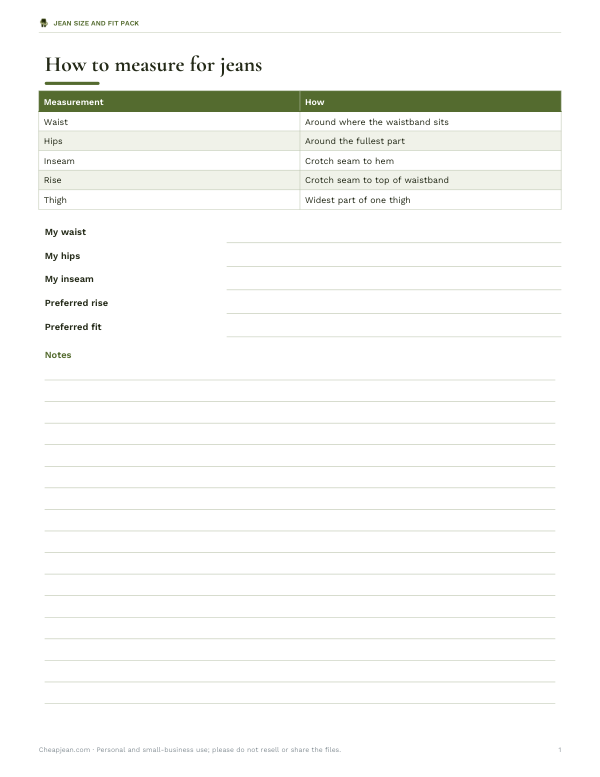
How to measure
| Measurement | How | Tip |
|---|---|---|
| Waist | Around your body where you want the waistband to sit | Keep the tape snug but not tight |
| Hips | Around the fullest part of your hips and seat | Stand with feet together |
| Inseam | From the crotch seam to where you want the hem | Easier on a pair of jeans that fit |
| Rise | From the crotch seam to the top of the waistband at the front | Tells you where the jeans sit |
| Thigh | Around the widest part of one thigh | Useful for slim and skinny styles |
Measuring a pair of jeans that already fit well is often more reliable than body measurements: lay them flat, measure straight across the waistband and double it, and measure the inseam along the inner leg seam.
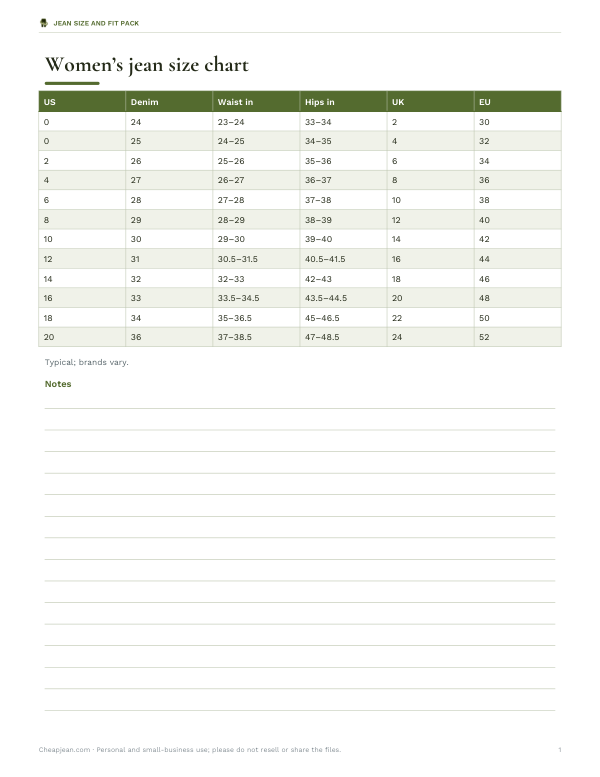
Women’s jean size chart
| US size | Denim size | Waist (in) | Hips (in) | UK | EU |
|---|---|---|---|---|---|
| 00 | 24 | 23–24 | 33–34 | 2 | 30 |
| 0 | 25 | 24–25 | 34–35 | 4 | 32 |
| 2 | 26 | 25–26 | 35–36 | 6 | 34 |
| 4 | 27 | 26–27 | 36–37 | 8 | 36 |
| 6 | 28 | 27–28 | 37–38 | 10 | 38 |
| 8 | 29 | 28–29 | 38–39 | 12 | 40 |
| 10 | 30 | 29–30 | 39–40 | 14 | 42 |
| 12 | 31 | 30.5–31.5 | 40.5–41.5 | 16 | 44 |
| 14 | 32 | 32–33 | 42–43 | 18 | 46 |
| 16 | 33 | 33.5–34.5 | 43.5–44.5 | 20 | 48 |
| 18 | 34 | 35–36.5 | 45–46.5 | 22 | 50 |
| 20 | 36 | 37–38.5 | 47–48.5 | 24 | 52 |
Typical body measurements; brands differ by up to a size, and vanity sizing means older and newer jeans may not match. “Denim sizes” (24, 25, 26 …) are used by many jean brands in place of US dress sizes.
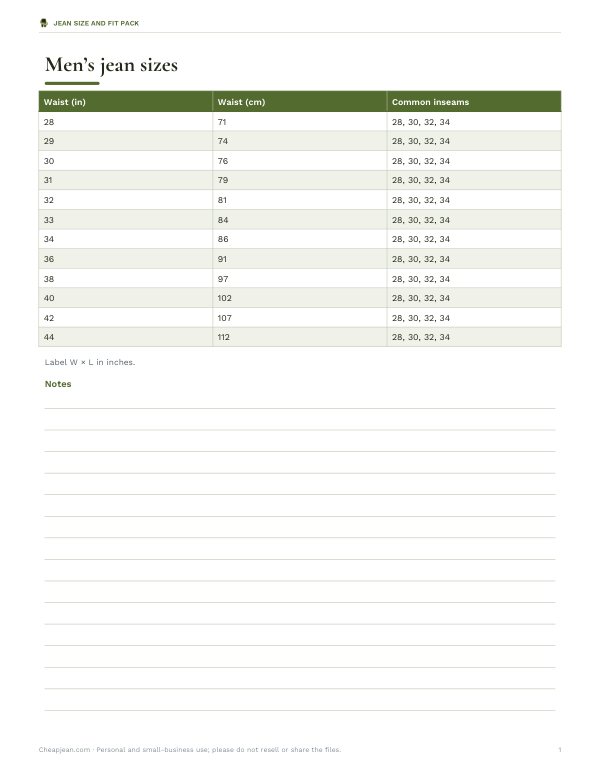
Men’s jean sizes
| Label | Meaning |
|---|---|
| W32 L32 | Waist 32 in, inseam 32 in |
| W34 L30 | Waist 34 in, inseam 30 in |
| Slim / straight / relaxed | Leg and seat cut, not the waist size |
Men’s jeans use waist and length in inches almost everywhere. The waist label is often a nominal size — measure the waistband of a pair that fits if you’re between sizes.
Rise and fit types
| Rise | Typical front rise | Sits |
|---|---|---|
| Low rise | under about 8 in | Below the hip bone |
| Mid rise | about 8–10 in | Just below the navel |
| High rise | about 10 in and up | At or above the navel |
Fit names — skinny, slim, straight, bootcut, wide-leg, relaxed — describe the leg shape and room in the seat and thigh. If your hips are much larger in proportion to your waist, “curvy” fits add room at the hip without a gaping waist.
Worked example
Someone with a 28-inch waist, 38-inch hips and a 30-inch inseam enters their measurements for women’s stretch jeans. The finder suggests US 6 (denim 28), UK 10, EU 38, in a regular length. With 40-inch hips instead, the waist still points to 6 but the hips to 10 — so the finder recommends the larger size or a curvy fit.
Converting between size systems
Women’s jeans may be labelled with US dress sizes (0–20), denim waist sizes (24–36), UK sizes (4–24) or EU sizes (32–52). As a rough guide, UK sizes are US + 4 and EU sizes are US + 30 for common ranges, and a denim size roughly matches your waist measurement in inches for mid-rise styles. These relationships are approximations — always use each brand’s chart when you can.
Measuring a pair of jeans that fits
- Button and zip the jeans and lay them flat.
- Waist: measure straight across the top of the waistband and double it.
- Hips: measure across about 7–8 inches below the waistband and double it.
- Front rise: from the crotch seam to the top of the front waistband.
- Inseam: along the inner leg seam from the crotch to the hem.
- Leg opening: across the hem, doubled.
Compare these garment measurements with the “garment measurements” many online shops list — they’re more reliable than size labels.
Stretch and shrinkage
- Stretch denim (with elastane) often relaxes during wear — some people size down.
- Rigid 100% cotton denim can shrink in hot washes and stretch at the waist with wear.
- Wash inside out in cold water and air dry to keep the size and colour.
- Raw denim may shrink noticeably on the first soak — follow the brand’s advice.
Privacy
Measurements stay in your browser.
Frequently asked questions
How do I find my jean size?
Measure your waist, hips and inseam and compare with the brand’s chart.
What size is a 28 waist in women’s jeans?
Often a US 6 (denim size 28), but brands vary.
What does W32 L30 mean?
Waist 32 in and inseam 30 in.
How do I measure inseam?
From the crotch seam down to where you want the hem.
What is rise?
The distance from the crotch seam to the top of the waistband.
Should I size down in stretch jeans?
Some people do, as stretch denim relaxes with wear — check reviews and the brand’s guidance.
Why do my jeans fit differently from last year?
Brands change cuts and fabrics, and sizing isn’t standardised between brands.
What inseam is “regular”?
Often about 30–32 in for women’s and 30–32 in for men’s regular lengths.
Do petite and tall jeans change the waist size?
Usually not — they change the inseam and sometimes the rise.
How much can jeans be hemmed?
Most straight and bootcut styles hem easily; keep the original hem for a vintage look by asking a tailor for a “euro hem”.